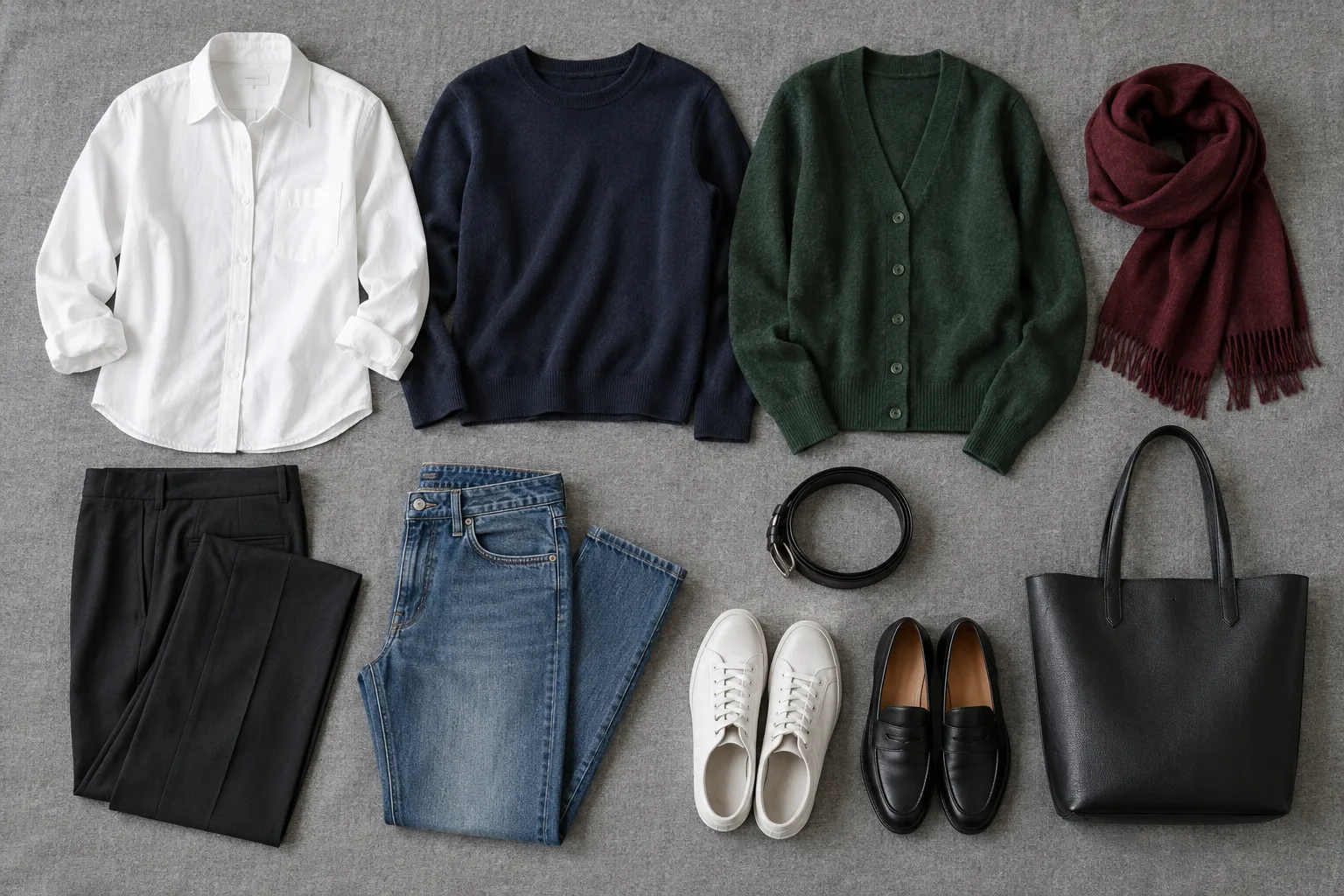
Turn the clothes you already own into repeatable outfits, identify the few gaps that matter, and shop with a clear plan instead of chasing every trend.
Updated September 8, 202612-minute readFour examples
A capsule wardrobe is a focused group of clothes that work together across many outfits. It does not require an all-neutral closet, a strict number of pieces, or an expensive shopping trip. The most affordable capsule usually begins with what you already own.
The goal is practical: fewer mornings spent wondering what to wear, fewer purchases that never leave the hanger, and more value from each item. This guide shows how to audit your closet, plan around your real schedule, choose a flexible palette, calculate cost per wear, and fill only the gaps that make several outfits possible.
Audit firstKeep what fits your body, life, and preferences now.
Plan outfitsTest complete combinations, not isolated garments.
Fill true gapsBuy only pieces that unlock several useful outfits.
Choose a two- or three-week period that represents your normal schedule.
Pull out the clothes you wear for those activities and seasons.
Create at least ten complete outfits from those pieces.
Notice repeated problems, such as missing layers or unsuitable shoes.
Rank those gaps by how many outfits each purchase would complete.
Set a total budget and wait before buying anything outside the list.
What a capsule wardrobe really means
A useful capsule is not a contest to own the fewest clothes. It is a working selection for a defined part of your life: perhaps everyday fall clothing, office outfits, travel clothes, or a warm-weather casual wardrobe. Formalwear, uniforms, exercise clothing, and sentimental garments can live outside it if that makes the system more practical.
The right size depends on climate, laundry frequency, dress codes, sensory needs, body changes, and the variety you enjoy. Someone who washes weekly in a four-season climate needs a different wardrobe from someone living in mild weather with daily laundry access. Treat numbers such as 20, 30, or 40 as planning prompts, not rules.
A good capsule passes three tests: its pieces fit and feel comfortable, they suit your actual activities, and most can be worn in more than one complete outfit.
Step 1: audit your closet without automatically discarding
Begin with the current season and the activities you do most often. Sort clothing into four groups: wear now, needs a small repair or alteration, seasonal or special-purpose, and uncertain. Move obvious donations only when you are ready; a capsule project should not pressure you into replacing an entire closet.
Try on the wear-now and uncertain pieces. Sit, reach, walk, and add the layer you would normally use. Check whether an item works with your current body and whether caring for it fits your routine. A dry-clean-only shirt may be beautiful but impractical if you need easy weekly washing.
Photograph successful outfits in a full-length mirror. The images reveal which tops need a different underlayer, which pants work with your shoes, and which colors repeat naturally. They also create a private outfit library for busy mornings.
Repair before replacing when the item is otherwise useful. Sewing on a button, removing pills, cleaning shoes, replacing a zipper, or having trousers hemmed can restore a favorite piece for less than buying an uncertain substitute. Compare repair cost with the garment's condition and expected future wear.
Step 2: plan for the life you actually live
Estimate how you spend a typical two weeks. If eight days are casual, four are office days, one involves a social event, and one is mostly at home, your wardrobe should roughly support that pattern. Do not devote half the capsule to imagined formal events while struggling to dress for everyday errands.
Write down practical requirements: weather, indoor temperature, commute, walking, childcare, pockets, footwear limits, modesty preferences, and dress code. These details matter more than a generic essentials list. A structured blazer may be valuable in one workplace and unused in another.
Include enough clothing to reach your normal laundry day, plus a small buffer. An unrealistically tiny selection can create emergency washing, faster wear, and frustration. Budget-friendly planning respects maintenance time as well as purchase price.
Step 3: choose colors from clothes you already enjoy
Lay out your most-worn pieces and look for two or three base colors. Navy, black, charcoal, denim blue, cream, white, olive, and brown are common, but none is mandatory. Then identify one or two accent colors or prints that make the wardrobe feel like yours.
A palette helps coordination; it should not erase personality. If burgundy, cobalt, floral prints, or bright green are consistently worn, keep them. The easiest accent colors already connect to your outerwear, shoes, or favorite patterned piece.
Check colors in combinations of three, not only pairs. A top may match two pairs of trousers but conflict with the only jacket you own. Photograph each proposed outfit under normal lighting to see whether the entire look feels coherent.
Step 4: build outfit formulas instead of a shopping checklist
An outfit formula describes a repeatable structure. Examples include straight-leg trousers plus a knit top and loafers, jeans plus a button-up shirt and cardigan, or a simple dress plus a jacket and sneakers. The formula stays the same while colors and individual pieces change.
Create three to five formulas for your most common activities. Then use your existing clothes to make at least two versions of each. This reveals whether the wardrobe is genuinely flexible. One white shirt that appears in every possible outfit is useful, but relying on it daily may not fit your laundry schedule.
Example capsule outfit formulas
Situation
Formula
Useful variation
Check before buying
Office
Trouser + knit top + blazer + loafer
Swap blazer for cardigan
Can the layers be worn indoors comfortably?
Casual day
Jeans + shirt + sneaker
Add cardigan or scarf
Do both shoe choices work with the hem?
Social plan
Dress + jacket + flat
Add belt or textured layer
Will the outfit suit likely venues and weather?
Travel
Soft trouser + tee + overshirt
Layer knitwear for temperature changes
Can pieces be reworn and washed easily?
Step 5: identify high-impact wardrobe gaps
A gap is not simply an item you do not own. It is a missing function that stops existing clothes from becoming usable outfits. Perhaps several tops need a weather-appropriate layer, work trousers need comfortable shoes, or a favorite skirt lacks a suitable top.
Write each gap as a specification: "washable navy cardigan, hip length, works over three shirts" is more useful than "new sweater." Include preferred fabric, fit, care, maximum price, and the outfits it must complete.
Rank the list by impact. The strongest purchase usually works with at least three items, fits a common activity, and replaces no functioning piece. If an item only creates one outfit or requires two additional purchases, leave it lower on the list.
A small selection becomes more useful when tops, bottoms, layers, shoes, and accessories can form several complete outfits.
Step 6: set a wardrobe budget that includes the hidden costs
Choose a fixed amount for the entire gap list, not a separate emotional budget for every item. Reserve part of it for alterations, repair, shoe care, laundering, or return shipping. A lower purchase price can become poor value if the garment requires expensive care or does not fit well enough to wear.
Use cost per wear as an estimate, not a promise. Divide the expected ownership cost by realistic wears. A $90 jacket worn 60 times costs about $1.50 per wear; a $25 occasion top worn twice costs $12.50 per wear. The calculation does not mean expensive is always better. It helps compare usefulness with price.
Set price alerts or wait for a sale when the need is not urgent, but compare the final cost, return terms, material, and fit. A discount does not improve an item that misses your specification. CouponEssentials can help you discover current deals and coupon offers, but always confirm terms with the retailer before checkout.
Budget guardrail: do not spend the full allowance at once. Buy the highest-impact gap, test it with your planned outfits, and revise the list before making the next purchase.
Four realistic capsule wardrobe examples
Example 1: the hybrid office week
Maya works in an office three days and at home twice. She starts with two trousers, dark jeans, four tops, a blazer, a cardigan, loafers, and clean sneakers. Her audit shows that a lightweight raincoat completes both commute and weekend outfits, so it ranks above another office blouse.
Example 2: the casual everyday capsule
Jordan needs washable clothes for errands, family time, and casual social plans. Three bottoms, five tops, two layers, and two shoe options already create enough variety. Instead of buying more tees, Jordan repairs a jacket zipper and adds one belt that improves several outfits.
Example 3: the five-day trip
Priya chooses two bottoms, three tops, one cardigan, one overshirt, a simple dress, and two pairs of shoes. Every top works with both bottoms, and the cardigan layers over the dress. She wears the bulkiest shoes in transit and avoids buying special "travel clothes" that would be unused later.
Example 4: the seasonal refresh
Alex brings last year's fall clothes out of storage and creates twelve outfits before shopping. The only repeated problem is a lack of comfortable weather-resistant footwear. One carefully chosen pair solves more outfits than a sale bundle of sweaters, so the shoe purchase receives the budget.
These examples are hypothetical, and none requires the same garment count. Each begins with existing clothes, defines real activities, and directs money toward the item with the greatest practical effect.
How to shop for missing pieces without restarting the closet
Take your gap specification, outfit photos, and measurements with you. For online orders, compare the garment measurements with a similar item that fits well. Size labels vary, so check the retailer's current chart, fabric composition, stretch, care instructions, shipping cost, and return window.
Secondhand stores, resale platforms, clothing swaps, outlet sections, and end-of-season sales can stretch the budget. Inspect condition carefully: seams, hems, closures, lining, pilling, odors, sole wear, and fabric thinning. Add cleaning, repair, platform fees, and shipping to the true price.
For a new item, test it against at least three planned outfits before removing tags. Move, sit, layer, and try the intended shoes. Check it in daylight and make sure care requirements are realistic. Return it within the stated period if it solves an imaginary need rather than the documented gap.
Avoid buying a near match simply because it is discounted. Wrong color, uncomfortable fabric, difficult care, or an awkward length can force more purchases. Waiting for the correct item is often cheaper than creating a chain of compromises.
Keep the capsule useful over time
At the end of each month, note what you wore repeatedly, what never felt right, and what caused outfit problems. Do not immediately replace an unworn piece; try different combinations or move it to a more suitable season. If it remains unused, identify why before donating or selling it.
Follow care labels, wash only when needed, treat stains promptly, air garments between wears, fold knits, and use appropriate hangers. Rotate shoes and address small repairs early. Maintenance protects the budget because the most sustainable purchase is often extending the life of something that already works.
Revisit the capsule when the weather, body, job, mobility, or household routine changes. A wardrobe is a tool, not a permanent rulebook. Adjusting it to life is more sensible than buying around an outdated version of yourself.
Frequently asked questions
How many clothes should be in a capsule wardrobe?
There is no required number. Many people begin with 20 to 40 everyday garments, but climate, work, laundry, and lifestyle matter more than a target.
Can I build one without buying new clothes?
Yes. Build complete outfits from what you own first, then shop only when a specific missing function appears repeatedly.
What colors work best?
Use two or three colors already common in your closet, then add one or two accents you enjoy. There is no mandatory neutral palette.
How do I start on a tight budget?
Repair useful pieces, set a fixed budget, rank gaps by outfit impact, and consider secondhand options before buying new.
Do shoes and accessories count?
They can, but counting is optional. Focus on whether they complete the outfits required by your schedule.
How often should I update it?
Review monthly and more deeply when the season, size, job, climate, or routine changes.
Is this only for minimalist style?
No. Capsules can include bright colors, prints, vintage pieces, and distinctive personal style. Coordination matters more than sameness.
What should I buy first?
Choose the missing item that completes the greatest number of outfits for your most common activities.
How do I avoid getting bored?
Change layers, proportions, shoes, accessories, and color combinations, and keep a few expressive pieces you genuinely wear.
Should I wait for a sale?
Waiting can help for a non-urgent need, but do not accept the wrong fit, fabric, or function merely because it is discounted.
Your final capsule wardrobe checklist
The clothes fit your current body and typical schedule.
You can name at least ten complete outfits.
Layers, shoes, and outerwear work with those outfits.
Care requirements match your time and budget.
Every proposed purchase fills a written, repeated gap.
The total cost stays within the budget after shipping, alteration, and care.
A capsule wardrobe succeeds when getting dressed becomes easier and shopping becomes more deliberate. Start small, use what you own, and let real wear reveal what comes next.