
Table of contents
Introduction Why office-supply spending gets overlooked Step 1: Know what you use repeatedly Step 2: Separate true needs from desk extras Step 3: Compare unit cost and refill timing Step 4: Watch for bulk-buy mistakes Step 5: Use school and office sale timing wisely Step 6: Build a simple supply budget Step 7: Use coupons and store pages with purpose Quick checklist FAQHow to Save Money on Office Supplies When Shopping Online
Office supplies often look inexpensive one item at a time, which is exactly why this category can quietly drain a budget. Pens are cheap. Notebooks seem cheap. Sticky notes, folders, printer paper, shipping labels, desk organizers, ink, and storage trays all seem manageable individually. But when these purchases happen often and without a plan, the total adds up faster than many people notice.
Online shopping makes this category both easier and trickier. It is easier because comparing options takes less time than store hopping. It is trickier because office-supply product pages often push bundles, quantity discounts, and add-on suggestions that make the cart grow beyond what you actually use. The good news is that this is one of the easiest categories to improve with a few simple habits.
This guide is designed for home-office shoppers, students, parents, remote workers, and small-business owners who want a cleaner system. The goal is to spend less without running out of the things that truly support work and study.
Helpful CouponEssentials pages for this topic include:
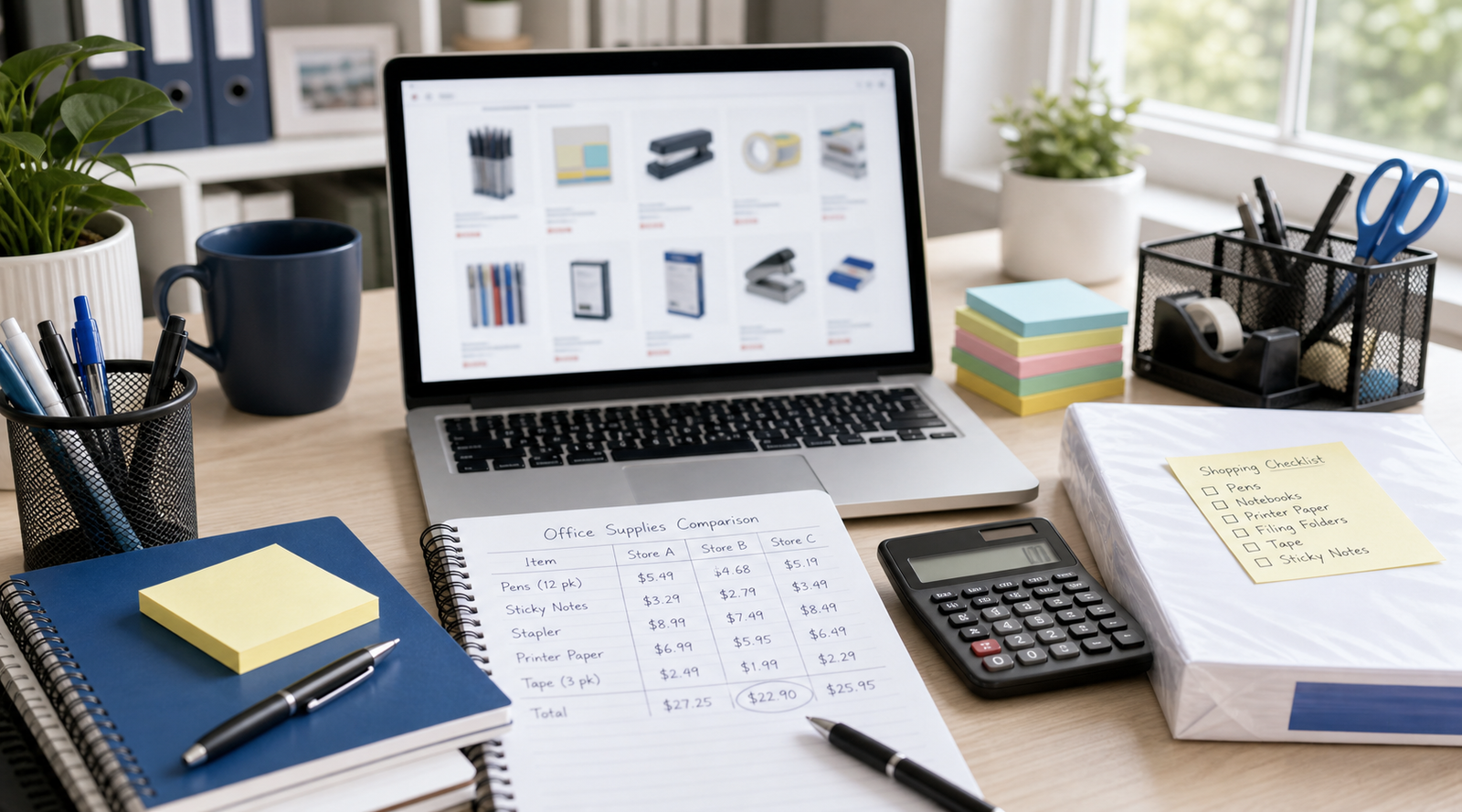
Why office-supply spending gets overlooked
Office-supply costs are easy to ignore because they rarely arrive as one large purchase. Instead, they show up in waves. A few notebooks this week. Ink next week. Paper after that. Then file folders, markers, shipping tape, or a desk accessory that looked useful during a productivity reset. These small decisions feel harmless, but together they can create a recurring spending pattern that is larger than expected.
Another reason this category gets overlooked is that online stores present office supplies as simple productivity upgrades. A sleek organizer or bundle of matching products can feel efficient, even when it is not solving a real problem. That is why office-supply budgeting works best when it starts with actual usage instead of visual appeal.
Small items hide the total
Office-supply costs often grow through repeated small purchases instead of one obvious big order.
Productivity marketing is powerful
Useful-looking desk items can feel necessary even when they are mostly decorative.
Replacements are predictable
This makes office supplies easier to budget well than many shoppers realize.
Refill planning matters
When you know what runs out first, online shopping becomes more focused and efficient.
Step 1: Know what you use repeatedly
The first step is to identify which supplies your home or workspace actually goes through on a regular basis. For some people, the core list is simple: pens, notebooks, paper, sticky notes, and printer ink. For others it includes folders, labels, shipping supplies, storage bins, dry-erase markers, envelopes, index cards, or desk-cleaning items. The point is not to list everything you own. The point is to list what truly needs replacement over time.
Once you know the core group, it becomes easier to stop reacting to random suggestions. A focused supply list also helps you see which products are recurring and which ones are just occasional extras.
Step 2: Separate true needs from desk extras
Many office-supply carts become expensive because useful-looking extras slip in. These can include matching organizers, extra pens beyond what you use, multiple kinds of planning supplies, decorative desk accessories, or duplicate storage items. None of these are automatically bad, but they should not be mixed mentally with the items that are truly needed for work, school, or home tasks.
A clean rule is to label purchases as either operational or optional. Operational items keep things functioning. Optional items may improve the environment or organization, but they should come from a smaller discretionary part of the budget.
Step 3: Compare unit cost and refill timing
Online shopping gives you a big advantage in this category because it makes price comparison easier. Still, the best value is not always the lowest package price. Compare cost per unit, expected refill speed, and storage practicality. A bulk box of pens is not automatically useful if half of them sit untouched for years. A large paper order may be smart for one household and wasteful for another. Ink savings matter only if the cartridge matches your real printer needs and does not expire unused.
| Supply type | Best thing to compare | Common mistake |
|---|---|---|
| Pens and markers | Cost per usable item | Buying big packs just because they look cheaper |
| Paper and notebooks | Use rate and storage space | Stocking too much without a clear timeline |
| Printer ink | Compatibility and real page value | Choosing price first and details second |
| Shipping and labels | Frequency of use | Buying business-size quantities for small needs |
Step 4: Watch for bulk-buy mistakes
Office supplies are one of the easiest categories for bulk-buy mistakes. The “buy more, save more” message feels logical because supplies seem timeless. But not every household needs the same quantity. If the product takes too long to use, creates clutter, or leads to duplicate buying because items are stored badly, the savings shrink quickly.
Bulk buying works best for supplies with steady, proven usage. It works less well for trend-based planners, novelty stationery, decorative organizers, or products you buy only occasionally. If you are not sure, start smaller and track what really gets used.
Step 5: Use school and office sale timing wisely
Timing can help in this category, especially around back-to-school periods, home-office refresh moments, and seasonal retail events. Stores often become more competitive on notebooks, pens, paper, desk accessories, calculators, and basic office tech during these windows. But the sale is useful only when it matches a real need.
A smart habit is to make a short list before major sale periods and shop with that list instead of wandering through every promoted item. This keeps spending efficient and stops discount excitement from becoming clutter later.
Step 6: Build a simple supply budget
A practical office-supply budget can be divided into three groups: recurring essentials, predictable refills, and optional upgrades. Recurring essentials are the supplies you know you need often. Predictable refills include items like ink or shipping labels that depend on use but still follow a pattern. Optional upgrades include organizers, decorative tools, or productivity extras that should not quietly replace the money reserved for essentials.
This structure keeps the category tidy and easy to review. It also makes it clear when you are paying for work support and when you are simply shopping for the feeling of being organized.
If more than one person uses the supplies at home, try keeping a simple shared list in a notebook or note app. When someone opens the last paper pack or notices the ink is low, add it to the list instead of placing an immediate order. This reduces duplicate purchases, prevents emergency buying, and makes it easier to group needed items into one cleaner order.
Step 7: Use coupons and store pages with purpose
The best way to use deals is to start from the need and let the coupon support it. If you already need notebooks, paper, or replacement ink, then a deal is useful. If a discount leads you to buy multiple optional desk items that were never part of the plan, the saving is probably weaker than it looks.
That is why targeted browsing matters here. Start with a short list, compare only the categories you need, and avoid expanding the cart just because a product seems neatly presented.
Quick checklist
- Identify the supplies your home or workspace uses repeatedly.
- Separate operational needs from desk extras.
- Compare unit cost, usage rate, and storage practicality.
- Be careful with bulk packs that exceed your real use.
- Use back-to-school and sale timing for planned restocks.
- Let coupons support the list, not create the list.
Office-supply savings are less about cutting corners and more about removing waste. When you buy based on actual use instead of low-pressure browsing, your cart becomes cleaner, your space stays more organized, and your budget feels easier to control.
FAQ
Is bulk buying office supplies always a good idea?
No. Bulk buying only helps when the supplies are used regularly enough to justify the quantity and can be stored in a way that prevents waste or duplicate purchases.
When is the best time to buy office supplies online?
Back-to-school periods and major retail sale windows often bring stronger prices, but the timing works best when you already know what you need to restock.
How can I stop overspending on office-supply extras?
Separate operational supplies from optional desk extras before you shop. This makes it easier to protect the budget for the items that truly support work and study.